German word order for main clauses and sentences with weil
Learn to locate the finite verb, move the time phrase and build a short reason clause without losing the thread.
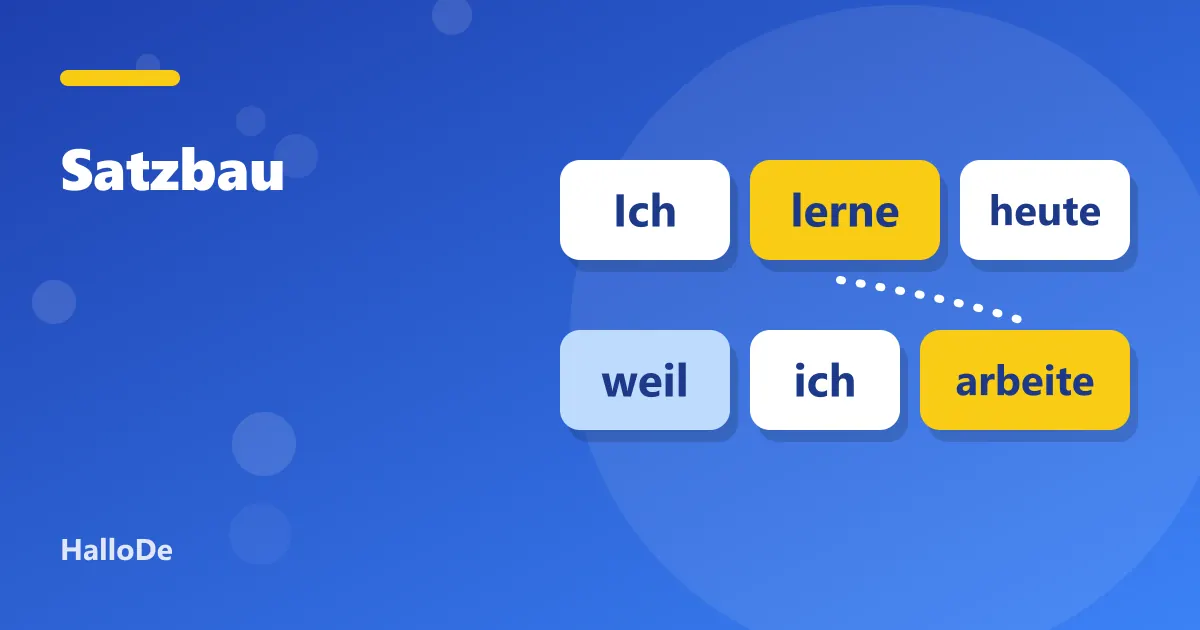
Move the time phrase as one unit
Say that you are learning German today. Then start with today. The finite verb stays in the second position in both statements, even though the subject moves. Position refers to a sentence element, which can be several words long. Make three cards for the example: the time phrase, the finite verb and the rest of the sentence. Move the time phrase to the front and decide where the subject needs to go.
Ich lerne heute Deutsch. Heute lerne ich Deutsch. Ich lerne Deutsch, weil ich in Deutschland arbeiten möchte.Mark the verb in a reason clause
Listen to the last sentence above and find the conjugated verb in the clause introduced by the word for because. Then write two versions of your own: one about learning German and one about missing an appointment. For now, use the standard written pattern when you are drafting an email or an exam response. Keep each clause short enough that you can hear where the verb belongs.
Correct the pattern in your own writing
Take an old message and circle the first element and the finite verb in each main clause. If an opening time phrase is followed by two subjects or a misplaced verb, rewrite the whole sentence. Next, underline each reason clause. Read the corrected message once at a normal pace. A sentence you can say comfortably is easier to reuse when a colleague asks you a question without warning.
Repair a message before sending it
The sentences below are sample learner errors. The writer wants to say they cannot come tomorrow because they have to work. Correct the word order and say the message twice, once starting with the time and once starting with the reason.
Morgen ich kann nicht kommen. Ich muss arbeiten, deshalb ich bleibe in Köln.With the time first, use “Morgen kann ich nicht kommen.” A corrected second sentence is “Ich muss arbeiten, deshalb bleibe ich in Köln.” To begin with the reason, try “Weil ich arbeiten muss, kann ich morgen nicht kommen.” The entire reason clause occupies the first position. The main clause then begins with its finite verb. Compare the two occurrences of the word for “I”, since they belong to different clauses.